Your brain builds REAL working magnets — and this super-power started 3.5 BILLION years ago with tiny bacteria!
Ready for the most mind-blowing science adventure ever? Let's go! ✨
↓ Scroll to explore the ancient secret ↓
LEVEL 1 • THE DISCOVERY
Wait... Your Brain Makes REAL MAGNETS?!
For ages, scientists thought iron in the brain was just floating around doing nothing special. Then they used an insanely sensitive machine called a SQUID magnetometer — it can detect the tiniest magnetic whispers.
🤯 MIND BLOWN MOMENT: It found actual magnetic crystals growing inside human brain tissue! Not fake. Not a metaphor. REAL tiny magnets your body built on purpose.
🧲 WHAT THEY FOUND
The magnetic stuff is called magnetite (Fe₃O₄). These are perfect little crystal magnets — some brains have over 100 million of them per gram in the protective layers around the brain!
🔬 HOW THEY KNEW IT WAS REAL
Using a super microscope (HRTEM), they saw the crystals have sharp, perfect shapes — like tiny gemstones cut by an expert. Nature doesn't make shapes this perfect by accident. Biology built them on purpose!
LEVEL 2 • ANCIENT ORIGINS
This Superpower Is 3.5 Billion Years Old!
The first living things that built magnets were tiny bacteria in the ancient oceans — way before dinosaurs, before trees, even before most other life!
🧭 WHY BACTERIA NEEDED MAGNETS
They lived in water and needed to find the perfect layer with just the right amount of oxygen and iron. Earth's magnetic field points slightly downward. By using their tiny magnets like a compass, they could swim straight down to the perfect spot — saving tons of energy!
⚡ MAGNETS WERE PART OF THEIR ENERGY SYSTEM
Scientists discovered the genes for making magnets are wired directly into the bacteria's "carbon fixing" system — how they turn CO₂ into food. Magnetite wasn't a side hobby. It was central to how early life survived!
LEVEL 3 • THE BLUEPRINT
The Magnetosome Island: The Original Recipe Card
Inside these bacteria is a special chunk of DNA called the Magnetosome Island (MAI) — basically the instruction manual for building magnets. It's huge (up to 130,000 letters long) and has four main teams of genes working together.
mamAB
The boss team. This is the minimum set needed to build any magnet at all. It pokes a pocket in the cell, pumps iron in, and starts the crystal growing.
mms6
The shape controller. It forces the crystal to grow into the perfect cubo-octahedral shape and has built-in "stop growing" signals so the magnet stays the perfect size for maximum strength!
mamGFDC
Fine-tunes the size so it's exactly right to be a powerful single-domain magnet (the strongest kind).
mamXY
Finishes the job by sealing the tiny bubble (vesicle) around the finished crystal.
🛑 THE VOLUME GOVERNOR (SUPER IMPORTANT!)
If certain genes are missing, crystals grow too big and become weak multi-domain magnets. Bacteria evolved a smart "stop signal" so magnets stay perfectly sized. Scientists are now looking for the human version of this stop signal — because in Parkinson's, magnetite that grows wrong is part of the problem.
LEVEL 4 • SURVIVED EVERYTHING
These Genes Are in EVERY LIVING THING!
Scientists compared the bacterial magnet genes to every major branch of life. They found 11 core versions that exist in animals, plants, fungi — even in us! Evolution kept them because they were too useful to lose.
🐟 PROOF IN SALMON
Salmon use magnetic sensing to navigate rivers. Scientists found the exact magnetosome-like genes are highly active in the salmon's nose cells that detect magnetic fields. The genes aren't just sitting there — they're working!
LEVEL 5 • YOUR DNA
Your DNA Has the Same Recipe!
Scientists matched the bacterial genes to human genes. Four teams in your DNA do exactly the same jobs as the ancient bacteria's magnet recipe.
🚚 TEAM 1: METAL TRANSPORTERS
SLC30A4, SLC30A8, SLC30A9 Pump iron into the crystal-building bubble.
SLC39A3, SLC39A4 Bring iron to the loading dock.
🏗️ TEAM 2: SCAFFOLD BUILDERS
HTRA1–4 Build the protein scaffold inside the bubble so iron crystallizes perfectly instead of turning into useless rust.
📦 TEAM 3: VESICLE FACTORY
PEX5, ANAPC7, CDC23... Build and organize the tiny bubble (vesicle) that keeps the chemistry controlled and safe.
⚡ TEAM 4: IRON CHARGE CONTROL
STEAP2, STEAP3 Control the exact electrical charge iron needs to become perfect magnetite. STEAP3 works specifically in dopamine neurons!
🔬 WHY WE KNOW THESE ARE THE REAL MATCHES
Scientists didn't just compare letters in the DNA. They compared the 3D shapes of the proteins — and found they fold exactly the same way at the atomic level. This proves they are evolutionary descendants of the original bacterial magnet genes!
LEVEL 6 • WHERE IN THE BRAIN
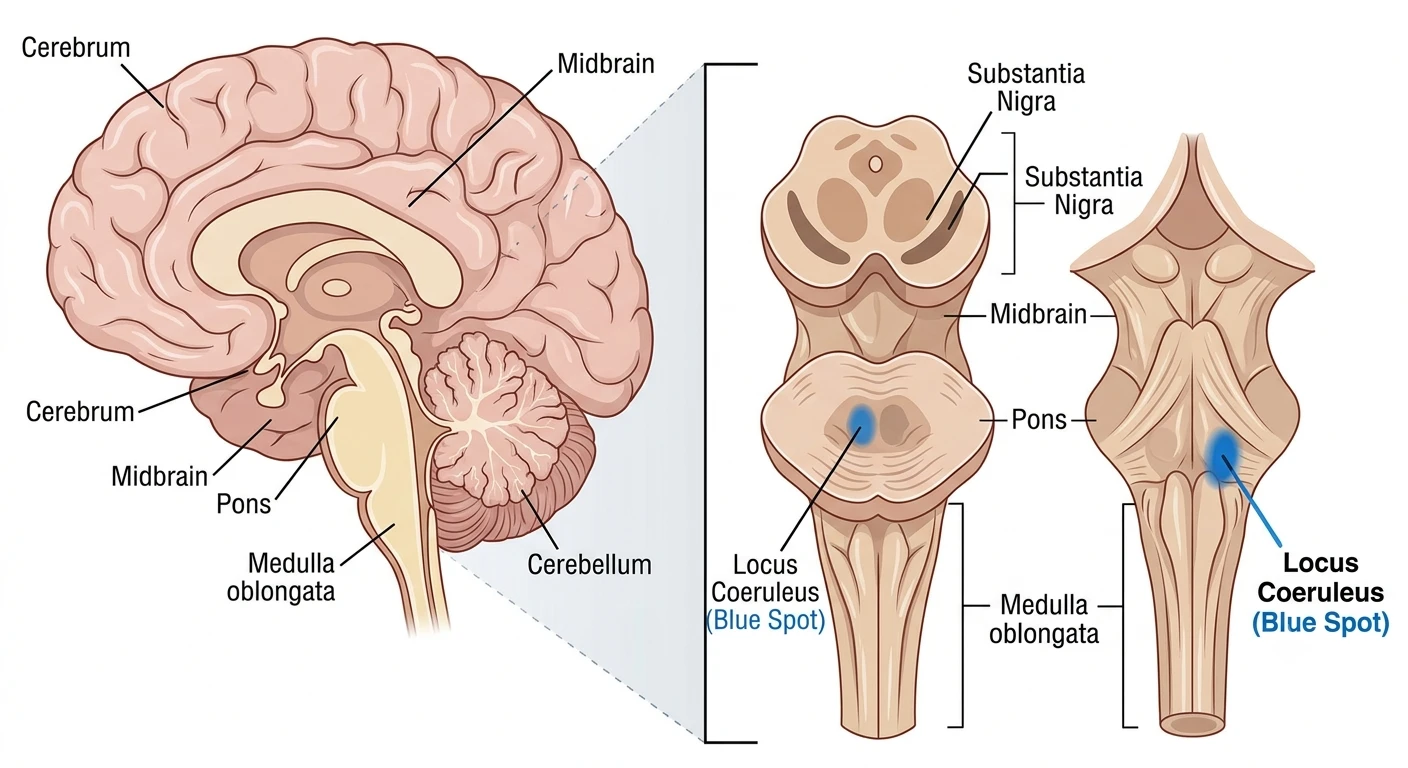
Deep in the Ancient Brain: Substantia Nigra & Red Nucleus
The magnets aren't in the thinking outer layer of your brain. They're concentrated in deep, ancient structures that evolved hundreds of millions of years ago.
🧠 The brain stem — midbrain · pons · medulla — sits deep beneath the cerebrum, home to the magnetite hot-spots like the substantia nigra.
🧠 THE TWO HOTSPOTS
Substantia Nigra ("black substance") — gets its dark color from neuromelanin. Controls smooth movement. First to be damaged in Parkinson's.
Red Nucleus — a major motor relay station. One of the most iron-rich places in the entire brain.
LEVEL 7 • HOW IT WORKS
The Cell Builds Magnets on a Real Assembly Line
This isn't random rust forming. Your cells have an active, controlled factory for making perfect magnetite crystals.
🔬 PROOF: STEM CELLS BUILD THEM FROM SCRATCH
When scientists gave human stem cells foreign magnetic particles, the cells broke them down... and then built brand new, perfectly shaped magnetite crystals using the iron! The assembly line is real and ready to run whenever needed.
LEVEL 8 • THE MC1R CONNECTION ★ NEW DISCOVERY
The Same Gene That Controls Skin Color Controls Your Brain's Magnets!
🌟 THIS IS THE BRAND NEW FINDING: The MC1R gene (famous for red hair and fair skin) also controls how much neuromelanin your brainstem makes. And neuromelanin acts as the perfect scaffold for growing organized, strong magnetite crystals!
More neuromelanin = better organized magnets = stronger, healthier magnetic architecture in your brain. MC1R genotype directly influences how well your brain builds and organizes its tiny magnets. This is a brand-new understanding of human biology!
🧬 WHY THIS MATTERS
Populations with different MC1R versions may have different neuromelanin levels, which affects how efficiently they organize iron into safe magnetite crystals vs. leaving dangerous free iron around. This gives scientists a completely new way to understand brain health differences.
LEVEL 9 • TWO KINDS OF MAGNETS
Good Magnets vs. Pollution Magnets
Not all magnetite in brains is the same. There are two very different kinds with very different effects.
✅ YOUR BODY'S OWN MAGNETS
Built by your SLC/HTRA/STEAP genes
Sharp, perfect crystal shapes
Precisely sized for max power
Acts as a detox system — locks bad iron into safe crystals
VS
❌ POLLUTION MAGNETS
From car exhaust & factories
Rounded, melted-looking spheres
Tiny enough to fly up your nose straight into brain
Attracts more iron and causes toxic clusters
⚠️ WHY POLLUTION MAGNETS ARE DANGEROUS
They sneak into the brain through the nose, travel to the ancient iron-rich areas, and magnetically pull the body's own iron into toxic clumps. Combined with disrupted natural magnetite building, this is linked to faster Parkinson's and Alzheimer's progression.
LEVEL 10 • WHEN THINGS GO WRONG
Magnetite & Neurodegeneration
In a healthy brain, the magnetite system is a hero — it grabs loose iron and locks it safely into crystals. When the system gets disrupted, it can turn destructive.
🔴 ALZHEIMER'S CONNECTION
The HTRA1 gene tries to clean up sticky amyloid plaques. As it works, iron gets funneled into the crystal pathway. The plaque can become an out-of-control magnet factory, creating reactive oxygen that damages cells.
🔴 PARKINSON'S CONNECTION
In the substantia nigra, neuromelanin normally helps organize magnetite growth. When it breaks down, iron forms chaotic toxic clusters instead of nice crystals. This damages the dopamine neurons that control movement. MC1R variations may influence risk through neuromelanin differences.
💡 NEW HOPE: A FRESH THERAPEUTIC TARGET
Now that we know the exact genes running the magnetite assembly line (SLC30A, HTRA, STEAP3), scientists have brand new targets for drugs or therapies that could help keep magnetite production healthy and organized — potentially slowing neurodegeneration before symptoms appear.
LEVEL 11 • THE COMPLETE STORY
The Epic Chain From Ancient Bacteria to You
3.5 BILLION YEARS AGO
Tiny bacteria in Earth's early oceans invent the Magnetosome Island — a full genetic toolkit for building magnets, tied into their energy system.
BILLIONS OF YEARS
The recipe gets passed into the ancestors of all complex life through ancient microbes. Evolution keeps it in fish, mammals... and humans.
SALMON PROOF
18 of the core magnet genes are actively working in salmon nose cells that sense magnetic fields. The system is still alive and useful in vertebrates!
YOUR DNA
Four gene teams (SLC, HTRA, vesicle, STEAP) run the same four steps bacteria invented billions of years ago.
IN YOUR BRAINSTEM
These genes work hardest in the substantia nigra and red nucleus — the iron-rich, ancient parts of your brain with the most neuromelanin.
MC1R CONTROLS IT
The same gene that influences skin pigmentation also controls neuromelanin levels — which directly organizes how well your brain builds strong, healthy magnetite crystals. Brand new discovery!
HEALTH & DISEASE
Pollution magnets + disrupted natural building = toxic iron clusters linked to Parkinson's and Alzheimer's. But knowing the genes gives us powerful new ways to protect brain health.
🧠 TEST YOUR MAGNET POWERS! 🧲
Answer these 4 quick questions and see how much you learned!
1. How old is the ability to build magnetite crystals?
2. What is the "Magnetosome Island"?
3. Which gene controls both skin/hair color AND how organized your brain's magnets are?
4. Where in the brain are most of the magnetite crystals found?
Your Brain Has Been Building Magnets Since Before the Dinosaurs! 🦕🧲
That incredible ability came from bacteria living in ancient oceans 3.5 billion years ago. The genes survived every mass extinction because they were too important to lose. They are still working inside you right now — in the deep iron-rich parts of your brainstem — building tiny perfect crystals that may help explain how brains interact with magnetic fields.
And the MC1R gene — the same one involved in skin and hair color — directly helps organize how strong and healthy those crystals are. This is a completely new chapter in understanding human biology!
Created by Vine · ORCID: 0009-0006-4312-526X
Based on: "The Genetic and Molecular Basis of Magnetite Biomineralization in the Human Brain Stem" DOI: 10.5281/zenodo.19037863
Enhanced interactive version for young explorers • June 2026